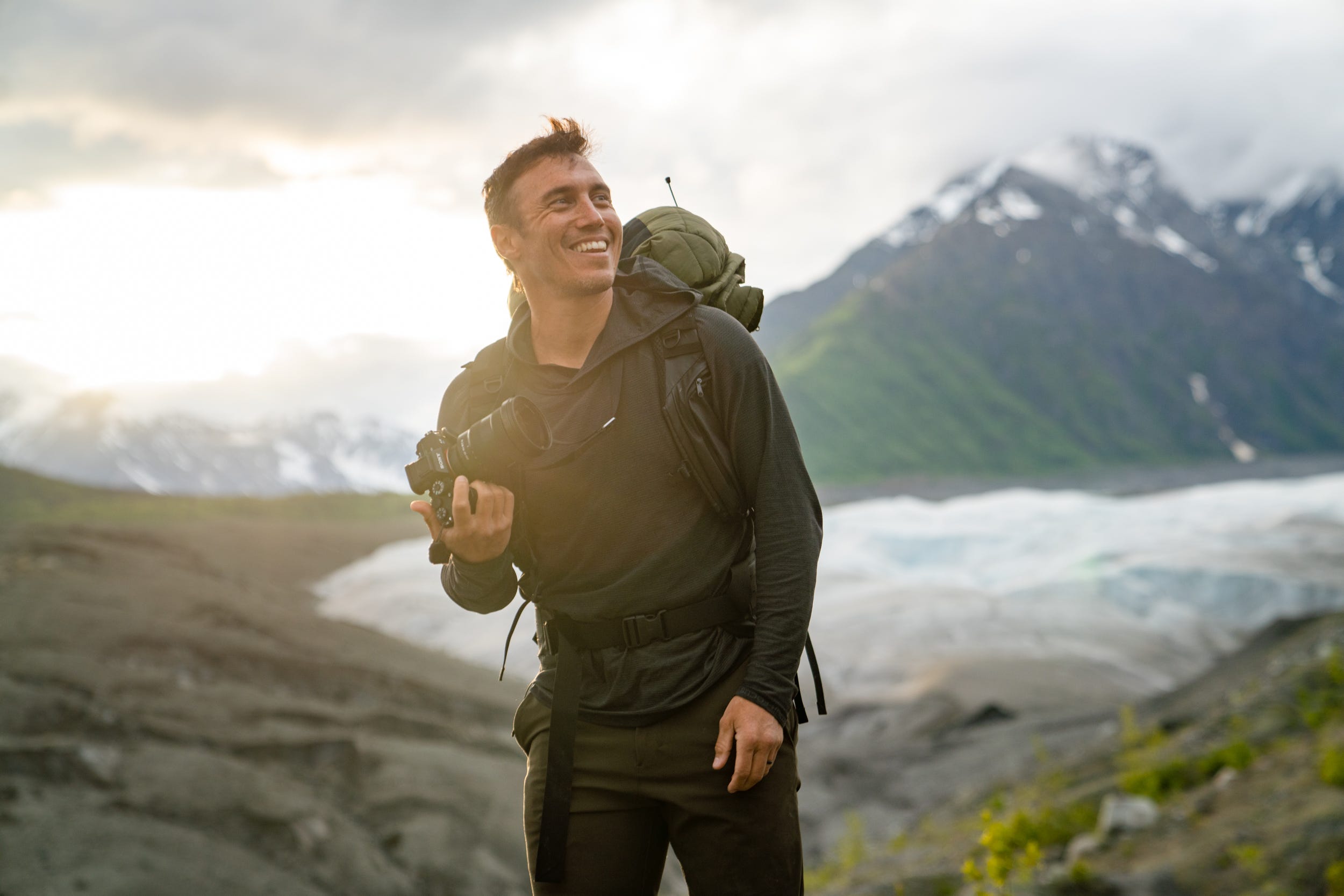
Paths Crossed: Chris Burkard
From Iceland to Kyrgyzstan to California, the renowned adventurer is refining his rhythms and his reason why.

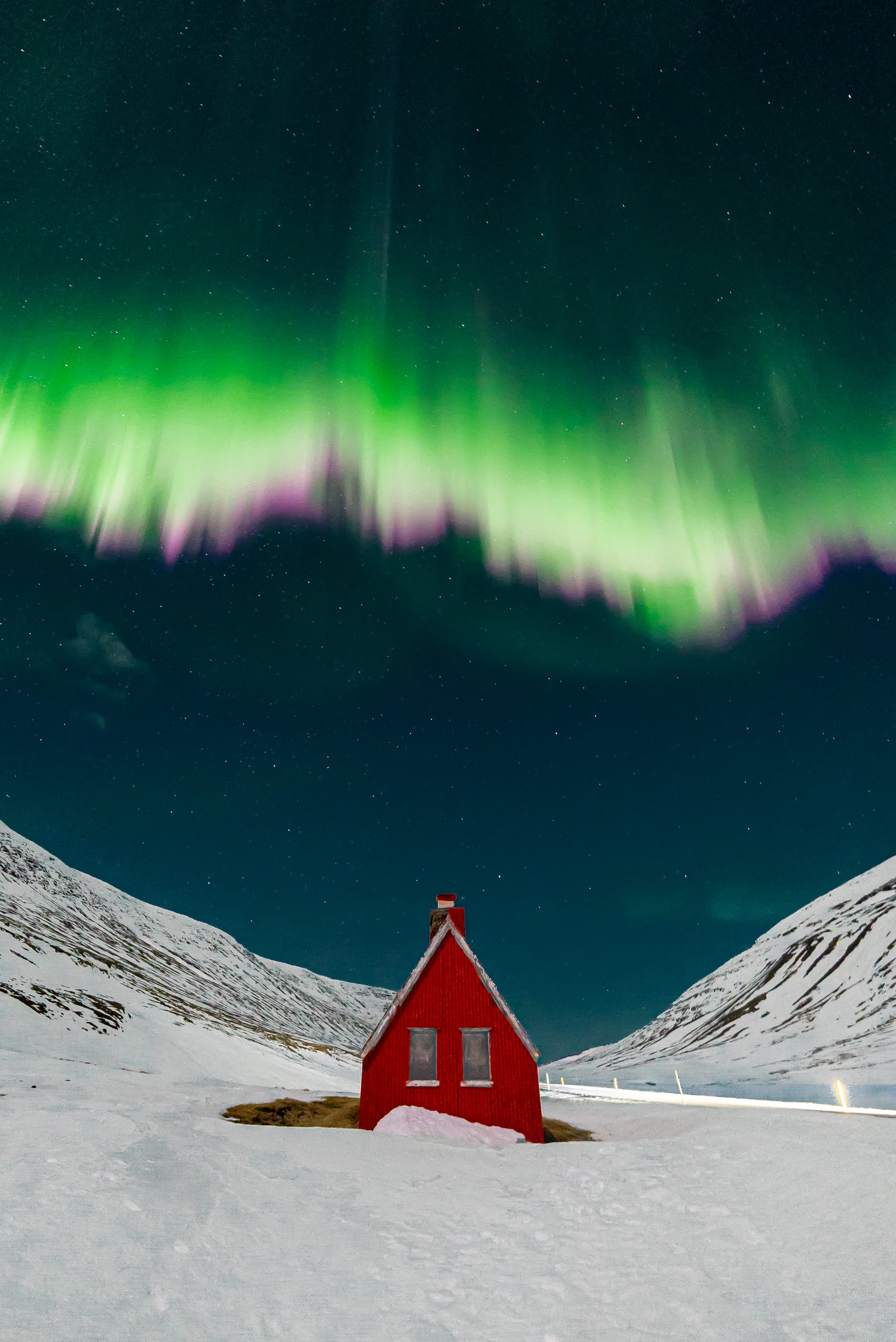
If, like me, you’re one of the millions following Chris Burkard, whether into the remote mountains of Kyrgyzstan to complete a 1,200-mile bike race, or as he treks across Iceland’s largest glacier, you’ve likely felt a jolt of inspiration in the photographs and stories he brings back from these expeditions. As Chris tells me, “Knowing that there are cool rewards for those willing to explore is super exciting. You start to think about where new experiences await.” This is what keeps him motivated.
It is apparent that the acclaimed author, photographer, creative director, and speaker spreads stoke wherever he goes, with boundless energy, endless joy, and a generosity of spirit. But I’ve been curious to talk to Chris about the quiet moments, the spaces between. What are his simple pleasures alongside the epic adventures? And what does he do with the heartache?
My conversation with Chris is right on time—his next birthday is 40—as we discuss the journey from external to internal achievements. We talk about honing our reasons why, and about how contentment is right in front of us. He tells me what his kids inspire in him, and how he defines home and bravery. I also ask the burning questions: Does this world traveler and endurance athlete ever sleep? But I definitely don’t ask Chris what’s next. Read on to find out why.
How would you introduce yourself? I was introduced to you via your photography, but I get the sense that your photos are just one facet of your creative life and all that you share these days.
The introduction has definitely changed over the years. I think you’re spot on. I don’t really align myself with being a photographer only. For me, it’s one of the tools in the tool belt that allows me to do what I love, which is to share life’s most vulnerable lessons and experiences with other people, with the assumption that maybe it will bring growth. But I don’t take my camera with me everywhere I go, and I don’t know that I would be proud enough to call myself a true photographer these days, when I know there are people who are so dedicated to that artwork.
I’ve tried to hone a number of other tools over the years to feel more competent in telling stories—that can look like directing films or branded work, or writing and publishing books. I think all of these modalities can be incredible for sharing experiences, which is what I advocate for—whether mine, other people’s, or sometimes an experience around a product. So I would introduce myself as a storyteller. Maybe that’s a little romantic, but that’s the dream.
With all your commercial success and the number of projects that must come at you, how do you decide what’s a yes and what’s a no? What drives you personally and professionally right now?
I read a book by Greg McKeown called Essentialism, maybe seven or eight years ago, and it changed my life and my perception about saying yes, and what it means when you are a “yes” person. I think I’ve been at risk of being that person because I grew up in a super blue-collar family, raised by a single mom, where saying no to work was almost sacrilege. Everyone wants to give you advice on how to do your job better or more efficiently, but nobody wants to give advice on when to say no and what effect that can have, because it’s the antithesis of everything we’re taught.
I’ve been like, Screw it. I’ll just work nonstop because the opportunities don’t stop coming. And that feels unfair to myself. Sometimes a yes comes out of responsibility or obligation or fear or whatever we think we’re missing. So I’ve been really trying to think about that in the last years—what am I actually advocating for? I’m more cognizant of asking myself, Why? Why say yes to this? What am I taking on? Do I need the money? Or am I doing this because it’s what my ego wants?
So what is the formula you’ve arrived at in general?
I try to have some kind of balance—well it’s never balance, that’s not realistic. Rhythm. I find some rhythm in saying yes to the big things that scare me, that require me to train or prepare. And with that, I’m aware of the time that my family needs and the time that my business needs. Usually it’s those three things that create the Venn diagram. So every year I look forward to one thing I really want to do while telling a meaningful story—that I can probably get funded and not really lose money on. I look at how realistic it is to dedicate a certain amount of time to something—because spending a month in Kyrgyzstan racing bikes is a huge ask from my family and the people that I’m responsible to.
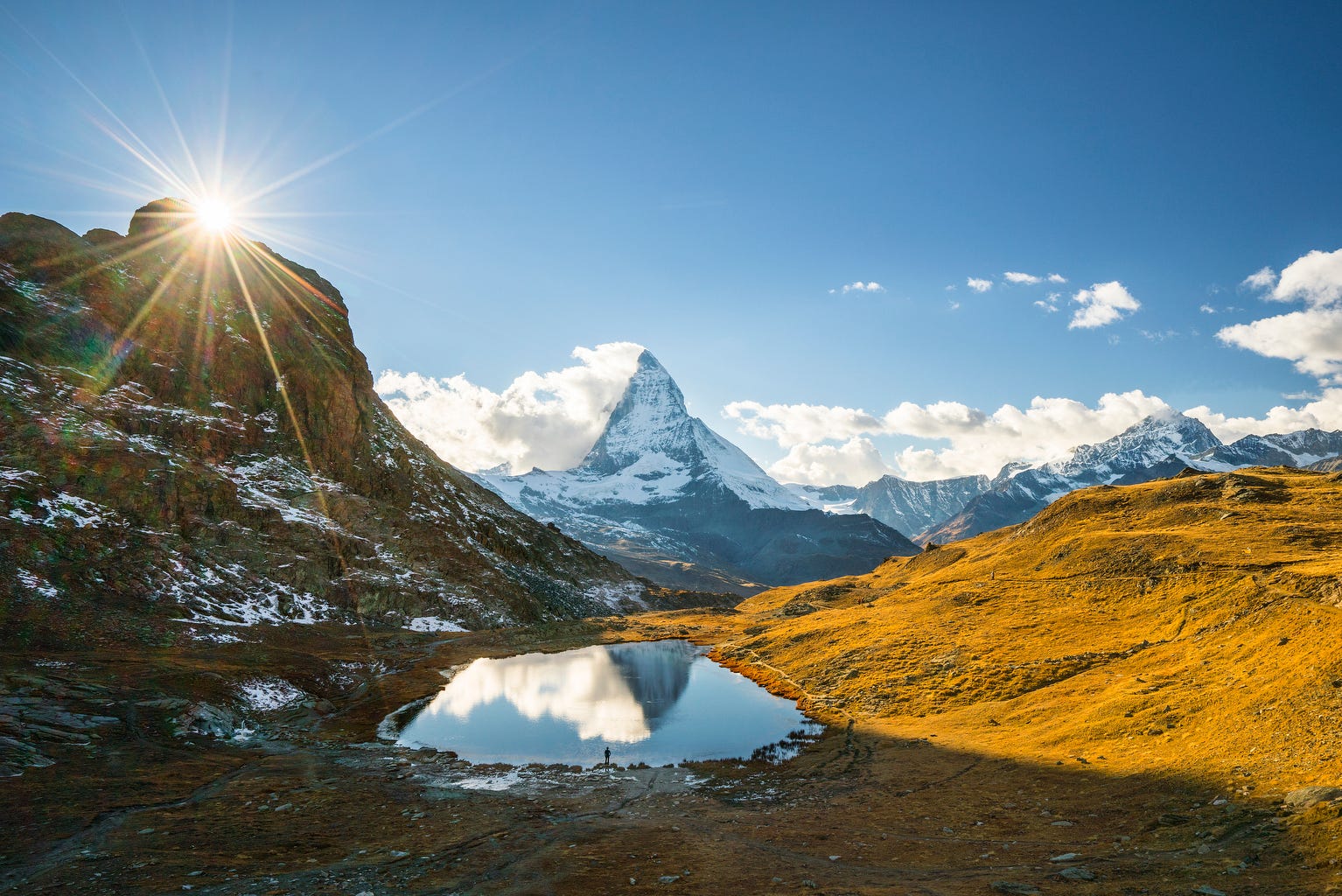
Right, you recently finished this unbelievable race—1,200 miles over 90,000 feet of elevation gain, and you placed fourth. Tell me why this one was important for you.
The race in Kyrgyzstan, the Silk Road Mountain Race, is one of the hardest mountain bike races in the world. Part of the reason I signed up is that I’m always talking to people about the importance of getting out of our comfort zone, why it’s critical for human growth. My comfort zone has become living in Iceland, this harsh, cold, remote place. On the outside it might look super gnarly, but we can get accustomed to a lot, so at a certain point the growth stops.
What isn’t comfortable for me is racing in a hot, muggy, slightly dangerous environment where the water is not clean and the resupply is limited. These things make a place like Kyrgyzstan beautiful in its own way, but it’s a very different experience than being in Scandinavia. As rugged as Scandinavia is, if you drop into any micro town, you’re going to have first-world healthcare. So in trying to crystallize some of these life lessons, I realized that I also have to continue to live up to the expectation I set for others.
I see you on these ultra-endurance missions, traversing the interior of Iceland, or casually biking from LA to California’s Central Coast. It has me curious if you’re a person who needs a lot of sleep?
I love sleep. It’s one of the most critical parts of life. But I also know that career, job, and life ask for us to go without it sometimes because of some goal. So doing things where you aren’t afforded a lot of sleep prepares you to make it more commonplace, so it’s not as scary when it happens. I think that’s a big part of training for big efforts—what does it feel like to ride a bike or to do a job when you’re running on little sleep? It’s not out of a desire to simply go without, it’s more that I want to get comfortable in this uncomfortable place.
You touched on rhythm versus balance. I’d made a note to ask you about “balance,” as the word does seem like an unrealistic frame we’ve been handed. I’m sure there’s no such thing when you’re a new parent or at the beginning of a big project or when catching a stride in a career. Relationships are hard anyway, and within this dance, I imagine the glue that binds has to be strong. What are your thoughts on all of this?
I agree with you big time. I think that the idea of balance is overrated. It feels like a buzzword, like “authentic” or some kind of green-washing scenario. I’ve found that rhythm is a much better way to describe how and what life asks of us, because there are seasons where you’re in this low point and then you’re going to come back up to a high point.
For me, it looks a lot like having excellent communication with the people that I care about—and not gaslighting myself or them in terms of what I’m capable of. Because at times I’ve convinced myself that I’m capable of this and this and this, when in actuality, I know that some of those things are going to fail. You’re not going to be able to be a great husband and partner and dad and business owner and athlete all at the same time. It’s just not feasible. So some seasons of life ask more of you in certain things.
I think to go back to earlier, nobody ever teaches you when you’re doing okay. That you can let certain things go. I’m lucky to have a partner who gets it, because I’ve been doing this for so long, and we’ve been together for such a long time. So there’s an understanding there. But at the beginning of a career it’s a lot harder—I don’t envy anyone who is starting out, because having any type of job in this adventure space asks a lot of you, and can be really complicated and stressful on a relationship.
And I’m sure people project onto you how cool or epic it all must be, but that’s not always the reality.
Exactly. No. What’s super interesting to me is that there was a time period in my life where I never fully understood people’s desire to fall out of the limelight on purpose. I’ve documented professional athletes and watched their pinnacle along their trajectory, and then when they purposefully choose to not be there. There’s an expectation placed upon you when you’re at the tip of the spear or the top of the mountain, figuratively and literally.
And it’s kind of amazing when you start to feel comfortable with, Oh, it’s okay if people forget about me a little bit—I’ve actually figured out what I really love in life and what I want, and I just want to do that thing for as long as I possibly can. So I’ve become a bit more at peace with what I can offer people. The coolest thing is getting to that place where you say, “You know, I might not be the right person for this project,” and being okay with that.
I feel like you’re just describing aging, hopefully—moving from hearing more of our internal messages rather than external ones. I was imagining that must be part of your journey after the hard work of building a career and gaining an audience along with it. You’ve amassed a following of 4 million humans on social media. But it’s probably easy to get pulled into following a cadence with your audience versus an internal, slower one.
I’ve never been great at learning lessons from others—it would be cool to be able to take on wisdom that other people have so graciously shared. But instead you have to go learn for yourself and make your own mistakes. It is interesting how we transition from needing approval from the world, from parents, from some man or woman in our life who represents whatever, to all of a sudden feeling like, You know, I don’t know that I need that approval or permission. I’m okay, I’m good, I love what I do.
If anything, I look for approval from my kids these days. And that’s a different place to be in. I love that place. As you experience enough of the world, the more you thrust yourself into harsh, wild, remote situations, you start to really hone in on which situations are most valuable. That honing-in feeling in a life and career is a really beautiful thing. It’s the gift of all that time spent.
What’s your relationship with being present? Are you able to be? What is wild for others is normal life as you’ve cultivated it, being immersed in beautiful places. So do you really see it all? I think about times I’ve been up in my head versus truly sitting in the beauty of the landscape I’m in.
Presence is a really hard thing to find. Mainly because so often we’re urged to look ahead. If you want to find some kind of peace, you have to look at where you are right now for sure. There have been seasons of life, decades even, where I have done nothing but looked ahead. And I’d love to say it’s that I’ve been looking ahead for my family, but usually it’s tied to work. And what’s really shitty about that is that it usually comes at the cost of relationships and people, or opportunities that you too easily assume will always be there when they won’t.
It’s so human.
Yes, and there’s always a next step or a next level. I can’t tell you the amount of times that I’ve sat at a film premiere or a book signing and people are like, What’s next, Chris? There’s nothing wrong with asking that question, it’s a good question. But I find it slightly offensive.
True. When is it enough to just be.
It makes you assume that there’s something better than you have now. And I think about five or six years ago I started looking around and being like, This is as good as it could ever be, and I don’t want for anything more. I’m so content. And then you start to look at whatever your excess is, and how you can give back to other people. I really want to advocate for being super happy with what I have. And people can tell—the world, your kids, your partner—they can tell when you’re satisfied. I think it’s important to try to understand what that satisfaction looks like, and what you’re really searching for.
What are your simple pleasures? You’ve gone deep into a lot of epic landscapes and experiences so I’m curious about this counterpoint.
That’s a great question. I don’t think I’ve ever been asked that before. I think because life requires me to be on the road, it’s having my little routine and some sense of familiarity that I don’t normally get. I’m not going to say I appreciate it differently than anybody else, but I appreciate it because it gives me a sense of safety—when you have a routine where you can go to your local coffee shop and get your cappuccino just the way you like it, and then go to the beach and surf the waves that you grew up surfing.
So much of life has asked me to leave life and family and people I love behind, so I am constantly ripping off a band-aid. Maybe traveling looks different for some. But for me, usually it’s going to take me out of my comfort zone, there’s going to be some elements of risk, or it’s going to ask a lot of me as I manage a crew, or have expectations from a client. So there aren’t many versions of traveling where there’s not a sense of anxiousness, despite the fact that I would call myself a professional traveler. So those are my simple pleasures—having that element of consistency, where you can go through your day a little more mindlessly or just wash the dishes.
That resonates, actually. I’ll never forget that the pandemic removed the paradox of choice for me and it was a relief in some ways. I had to settle into one space for over a year after being quite nomadic. Cultivating routines and rituals doesn’t come naturally for me, despite realizing that those are the things that make you feel safe and in control. This is a complementary question, but do you have day-to-day rituals?
When I’m home, I try to go surf in the morning when it’s glassy. I get up, drop my kids off at school, and usually just body surf and swim in the ocean. And then I go mountain bike in the afternoon. If every day looked like that, I’d be a pretty happy person. And what’s cool is I’ve found that same rhythm of life in other places, and it fills me up just the same. My career has asked me to consume—I have to have the cameras, the equipment and the gear, and there’s a lot of shit that comes with running a production studio. But in my heart, I’m a minimalist.
I can sense all the stoke and the joy. What do you do with the heartache?
That’s a great question. There is heartache. You can’t get around that, it’s the one thing in life that will find you. I try to share that with people I love and people I trust. And I think that has been one of life’s better lessons in the last ten years. I don’t ever want people to think that this career path and any of the success that I found comes without great cost. Because it did, and this is probably the byproduct of not going to college and just putting everything you have into work. So I’m trying to reinvest in relationships and people and make up for lost time. I’m realizing the value that’s there—these people can help hold or create a container for these big emotions and feelings. Things catch up with you, the pain, making poor decisions. So I’m having to deal with those things now. I’m 39, almost 40, which is wild.
It’s wild indeed. Just wait, I have no idea where the first half of my 40s just went. I think you are right on time at 40 as to when we begin to unwind a lot of the built-up pain and crud. The alternative is keeping it buried, and like you already said, you or others in your life are going to feel it anyway, even if you think you have it under control.
It’s true. I cannot wait for my 40s. Though I can see a pattern emerging where the mind is very willing, but the body starts to slow down.
What is your definition of home? You just left Iceland, where you and your family lived the last years, and moved back to California. But as someone who has lived abroad as well as someone who is on the road a lot, do you have a sense of what that is for you?
Home is complicated, right? There are a lot of cliched versions like, “Home is where the heart is.” I don’t know about that, to be honest. I think there was a time when I felt like it was a very cemented thing. But I’ve never been somebody who’s like, This is home; this is it. And now I feel so much more comfortable knowing that I can thrive in another culture, in another place with different ideals or political views or things that people care about and value. And that makes the world feel like a safer and more open place to me.
I have been trying to share this concept with my kids, that just because I grew up thinking that home has this one version, I don’t want them to feel like that. I want them to feel like they can make a choice and it doesn’t need to be that scary. And yes, it can suck to leave behind people that you really care about. But at the same time, anybody that truly wants the best for you would urge you to go explore the world and live where you feel called. And whether that leads you back to where you came from, great. If not, no worries. I think, for me, it’s also looked like exploring what it means to come back to the place that you grew up under your own terms.
At the end of the day, what it really boils down to is figuring out where that environment is that’s going to allow you to be the most honest version of yourself. And sometimes home, as comfortable as it is, creates a lot of masks we wear with the people who knew us at a certain age—and expectations that come with that in how we act and operate. I’ve seen people reimagine their version of home and create a fresh start. And that’s a beautiful thing.
It gets harder to be the one always leaving people, but in terms of putting yourself in different environments to feel out the most honest version of yourself, that’s definitely been my impetus for traveling between various communities.
My goal is to treat every moment that I get to spend with somebody like it might be my last. I know that’s a hard thing to wrap our heads around, but it has offered me the perspective to make the most of every opportunity I’ve been given. And that perspective has been a huge driving force to go do the expeditions that I’ve done, and choose to take opportunities when they come.
If there’s anything that I’ve gotten better at over the years, it’s recognizing when an opportunity is coming and knowing that those opportunities never come for those who are fully prepared, who feel like they’re ready and their bags are packed. Usually it looks like showing up at the train station as the train is leaving, bags strewn about, and you just have to go.
How would you define bravery? I am quite adaptable, and what you describe is generally comfortable to me. But while I sometimes wish for someone I love to step off the edge, when I can see it would bring them into more alignment and happiness, I cannot just project my way of being onto someone. Plus, doing something in our backyard, or within a relationship for instance, might be the bravest thing in the world.
Great question. I would say bravery, to me, looks a lot more like being willing to embrace experiences outside of your comfort zone. That’s the umbrella, but it can look like just being willing to head into uncomfortable situations, which, as you say, doesn’t have to involve leaving your house. I think some of the deepest journeys you can take are going to be the internal ones. Addressing those relationships and issues that are challenging will inspire growth. I don’t know that that requires everybody to go surf in freezing-cold water. In fact, it’s probably the opposite. Some of the bravest people I know are the ones who face uncomfortable situations head on and find a path through. That can be in a conversation, a trip you’re hesitant to go on, or in taking a risk to spend money on that thing for your business. I feel genuinely attracted to people who are brave in that regard.
What surprises you? You’ve probably seen a lot.
Wow. I’m trying to think about that. Kids surprise me because of the way their brains work. There’s a creativity there that is so easy to lose as we get older. And it’s frustrating, because when you filter everything through this list of responsibilities and roles, it’s easy to forget that just to feel or experience something is the purpose. So kids are the ultimate reminder of that—they are absolutely existing in this creative space. What’s cool for me is to try to foster this for them, keep that excitement and interest going. And then it informs how I want to be.
What are you most proud of right now?
I’m most proud of the vulnerability in which I’ve been able to share a lot of my life’s most meaningful experiences. And I think that has taken a long time to come to terms with and feel comfortable with in a world where I don’t think a lot of space is given to men to be vulnerable and/or to share personal things. So when I’m making a film or a book or speaking, I really try to infuse who I am as a person and not hold back. And that feels important.