
Paths Crossed: Timmy O'Neill
The rock climber on the big and banal questions, the Dark Wizard, and the audacity of life.

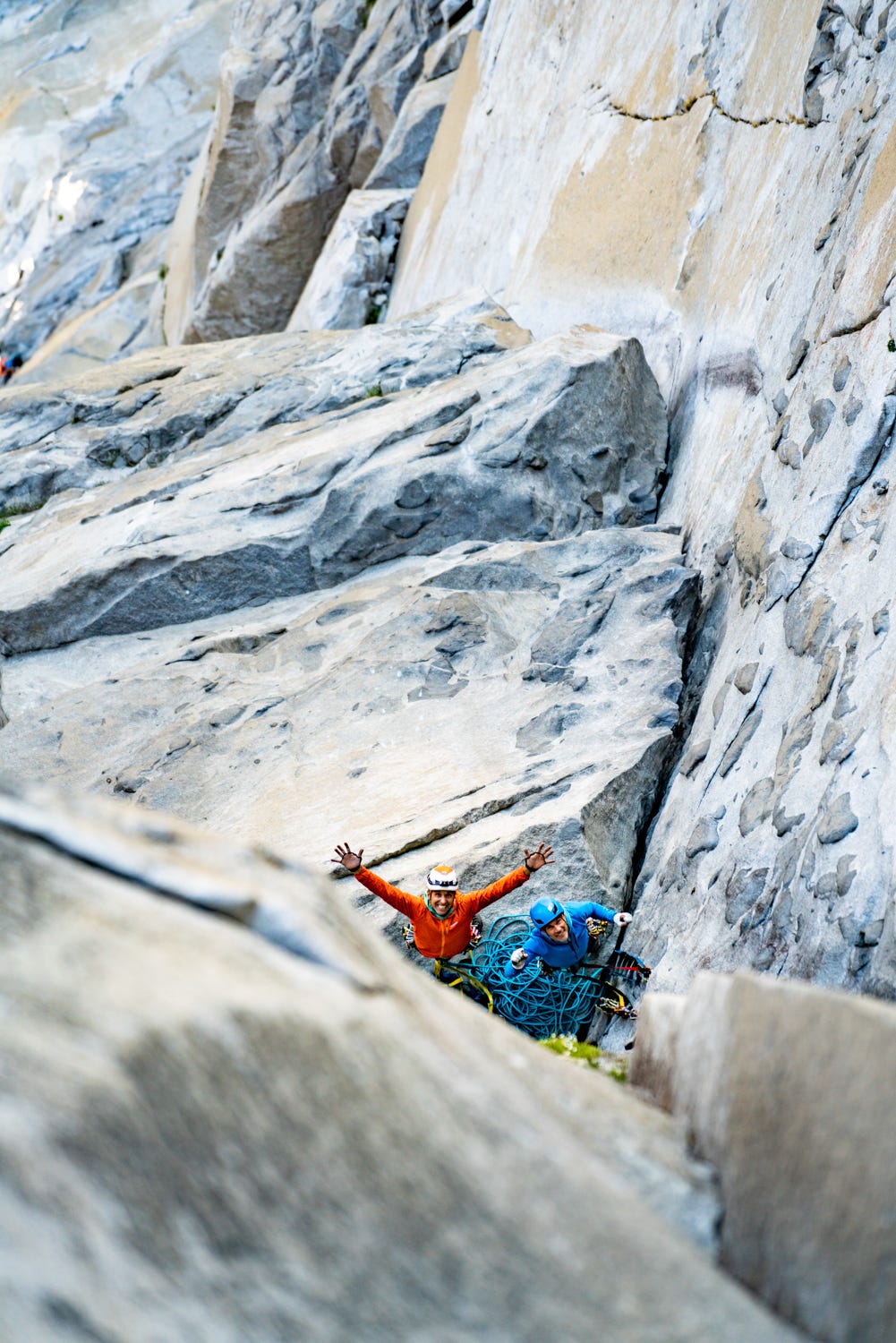
Timmy O’Neill introduces himself as a climber, kayaker, and father of two. I’d throw in great writer, comedic storyteller, and voracious reader—I’ve caught him on the mic over the years while MCing annual gatherings in Yosemite or reading in-store at Patagonia from pieces he’s published in their journal. Timmy leads with his heart in all that he does, whether exploring record-breaking terrain on the rock, traversing the landscapes of innumerable books, or writing letters that interrogate the larger meaning of existence—letters purposefully penned to friends around the world and mailed out by the hundreds.
As a climber, Timmy is part of a lineage of Yosemite characters who immersed themselves in the Valley and made the impossible possible—his generation of the late nineties and early aughts was famously coined the “Stone Monkeys.” HBO’s recent Dark Wizard documentary is a 4-part series that explores the life of Dean Potter, one of these infamous monkeys; it features Timmy, among others, as he processes their complex friendship and partnership. Together in 2001, Dean and Timmy were the first to complete the Yosemite Triple Crown, linking up three of the most prominent big walls in the park—7,000 feet of climbing in under 24 hours.
From first ascents to fatherhood, we get into it all. We talk about why we climb, what is most misunderstood about this pursuit, and how we define home. I get Timmy’s reading recs, and discover that receiving mail from him is a real gift—his creative projects, PicPickPost and Life Notes, are ongoing testaments to love. Most importantly, Timmy teaches me that “despair” is an anagram for “diapers.” This is a beautiful conversation on life, death, wonder, and the infinite now. Enjoy.
We met, at least officially, at the LA premiere of the Dean Potter documentary, The Dark Wizard. What was it like seeing footage of your younger self during that era of Yosemite’s climbing history?
To be trapped in amber is always a bit surprising. Video is more visceral than a photo, so to see my younger self at 30 and then to see my older self at about 55, when I did the interviews [that weave through the documentary], is seeing 25 years of change. There were a lot of things that I felt from watching that—I’d already seen all four episodes so I could see how they were using me before it was released.
Can you touch on some of what you felt? It must have been full of complexity.
Recently, someone asked me: Was anything revealed to you about Dean that you hadn’t thought of or seen? I knew all the stories—I’d heard about China, I’d heard about the Scottie Burke offwidth—but I hadn’t seen it. Seeing the footage, it made me realize that Dean wasn’t trying to kill himself; but he was consistently trying to get himself out of circumstances that would have killed him. And it was startling to see how often he was near death. Perhaps being near death brings you near life—helps you remember it, helps you thirst for it.
I was surprised to find tears welling in my eyes as I watched some of the footage, specifically while he was climbing on the Eiger. I think it was a visceral reaction to the multitudes we contain, to our humanity.
After I watched all four episodes I immediately called Brad [Lynch], who is in the film. He didn’t pick up, so then I called Jim [Hurst]. I wanted to be with the living. I wanted to be with people that knew me and knew Dean. “God, dude, I feel so sad,” I said to Jim, “so heartbroken with loss, and the destructive end that he met.” But it’s not only that—yes, that is a deep and profound data point. But it’s a constellation that’s made up of many points, and it still has beauty, it still has a luminescence.
It all got me thinking about the various frequencies with which we can approach any act one day to the next, climbing in this case—via pure joy and awe or untenable energy and deep pain. I appreciate your reflections, thank you. How has your relationship to climbing evolved across the years, from breaking speed records on the Nose with Dean to now?
I’ve always lived expeditiously, and during my heyday, yes, I was a main part of those Stone Monkeys. And when you take an expedited disposition and a high physical capacity, it can create record-breaking times and unimagined ascents. So it fit me very naturally. I am still really interested in trying to cover as much ground as I can, and I find myself covering more philosophical, psychological, and intellectual ground than when I was in my heyday as a physical specimen. But I’m still a very fast climber. I want to get there, have the experience, and depart.

That’s a good turn of phrase, “my heyday as a physical specimen.”
I’ll be 57 at the end of June. You don’t have to get old if you die young, but if you do live a long time, then there is a natural declivity that you live on. For me, especially now as a father, that case is even more evident—in the last three and a half years, my wife Sarah and I have had two children. Now we go to places where I would do these fantastic climbs and kayak experiences, and we just go and look at the setting. We don’t even engage—which is fine, because our children can’t engage like we can. So that helps me create a slower pace. Doing nothing becomes everything.
How do you make choices about getting outside now—is it prioritizing time with friends, or are there certain objectives and places you want to get to?
I live in a destination. It’s all around me in Tahoe, so I’m already here. And then I’ve never really needed a list, because I live in the bucket—it’s all either intersecting now or it’s parallel and available soon. So I get outside at least once a week to climb with a local partner. Just being there and doing that act together is the goal. So that’s successful.
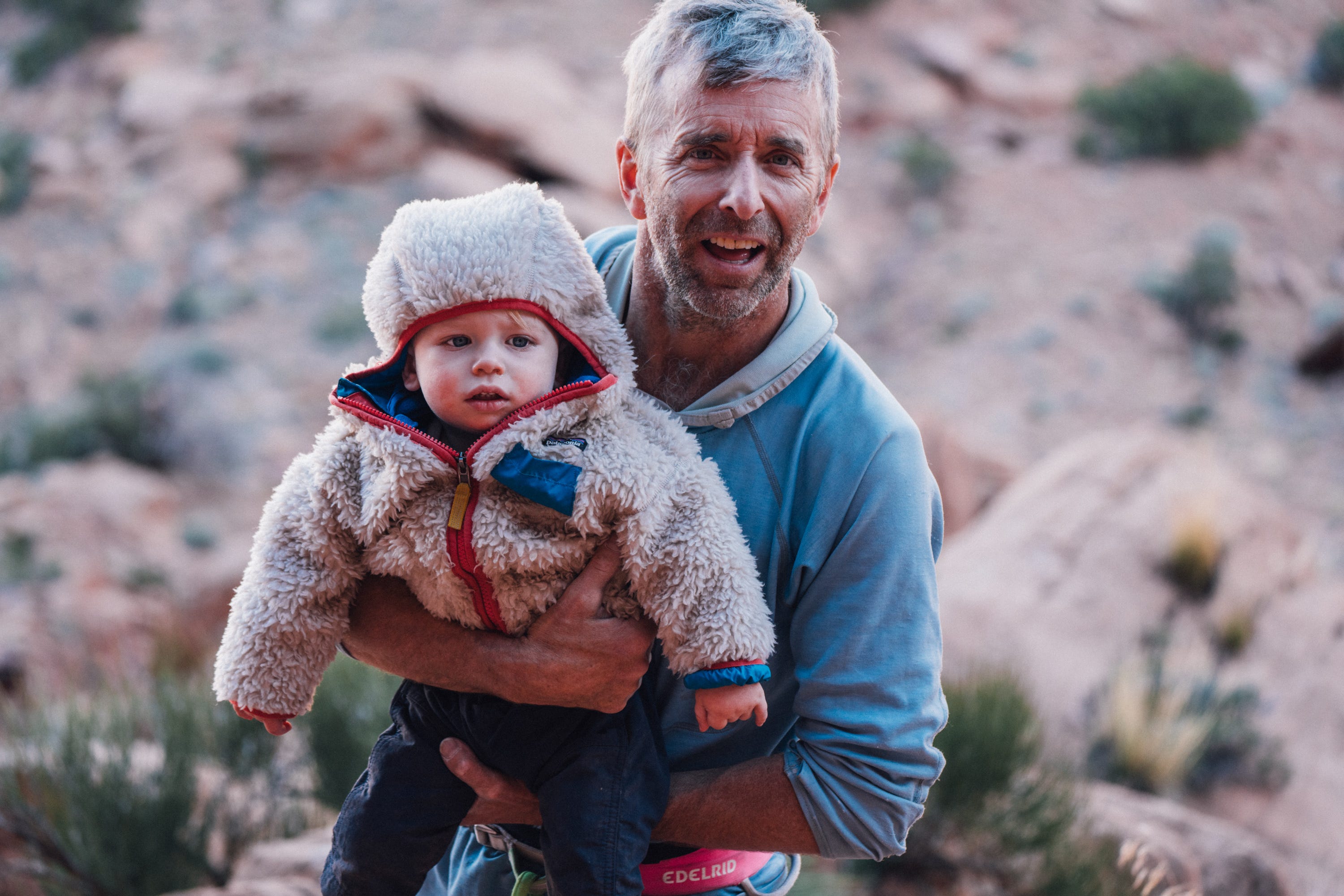
And then I will go climbing with my little son and another friend and his little son, and that’s so dear. I have this potential to bestow my children with my outdoor knowledge, this intentional mindset around climbing and kayaking and hiking. I can take the best parts of myself and share them in a way that teaches them to be available, not in an accidental way, but in a purposeful one.
When did you know climbing was it for you?
It was instant. As soon as I did it, I was like, ‘Oh, this is what I’m going to do for the rest of my life.’ My six siblings are all still in Philly. So it seemed as if I would be staying as well. And it wasn’t that it was bleak; it just wasn’t exciting. It just wasn’t new. I did a year of university, and I thought, ‘No way, not more of this.’ And then I did a year as a roofer—which is a really difficult job—and I thought, ‘Okay, this is not for me either, I don’t want to get into the trades—there’s got to be something else.’ But I didn’t know what it was. And then I found climbing, and there it was: ‘Oh. This. This is the best answer that I could have to: Who am I? What should I do? What is the point of existence?’ Climbing checked every box.
Where was that first climb?
In Bozeman, in Hyalite Canyon. A store was offering a free clinic, and my roommate suggested we go. I was working in Yellowstone, so we drove up there and I tried it. It was so rad. And they were like, “You’re good.” And I go, “No, I’m great.” I went to Yosemite the next summer. Then I bought a rack and went to Joshua Tree that winter. That was it, I was in.
Do you remember the first moment you drove into the valley?
It’s classic. You look up and El Cap is baffling. You can’t believe the size of it, how humbling it is to be below such mammoth formations. They look impossible—how can you ever get up them? But then eventually, years and years later, you do it. What seems impossible becomes “I’m possible.” And then Dean and I gained such mastery that we were able to do the first three grade VI walls ever in a single 24-hour push.
The Yosemite Triple Crown—climbing El Cap, Half Dome, and Mt. Watkins in a day. I found an article from Scott Bennett about your place in making that history that readers can check out, with a classic photo of you and Dean at the end of the push. What do you think most people misunderstand about climbing?
The value proposition. People can’t get past the risk—that it’s an unnecessary, untenable risk. Why would you bother putting yourself proximally to such great harm? So I think that’s misunderstood. And that’s fine, because it’s not my job to have somebody understand what I love. It’s my job to understand what I love.
That’s a great reminder for me, those last couple sentences.
There is a risk component every day that we get in our car and agree that we’re not going to cross over the double yellow line. But meanwhile, there are many, many times that somebody is passing you at a high rate of speed in a very heavy object. And we just accept that because it has a conventional metric. The value proposition is easy to determine.
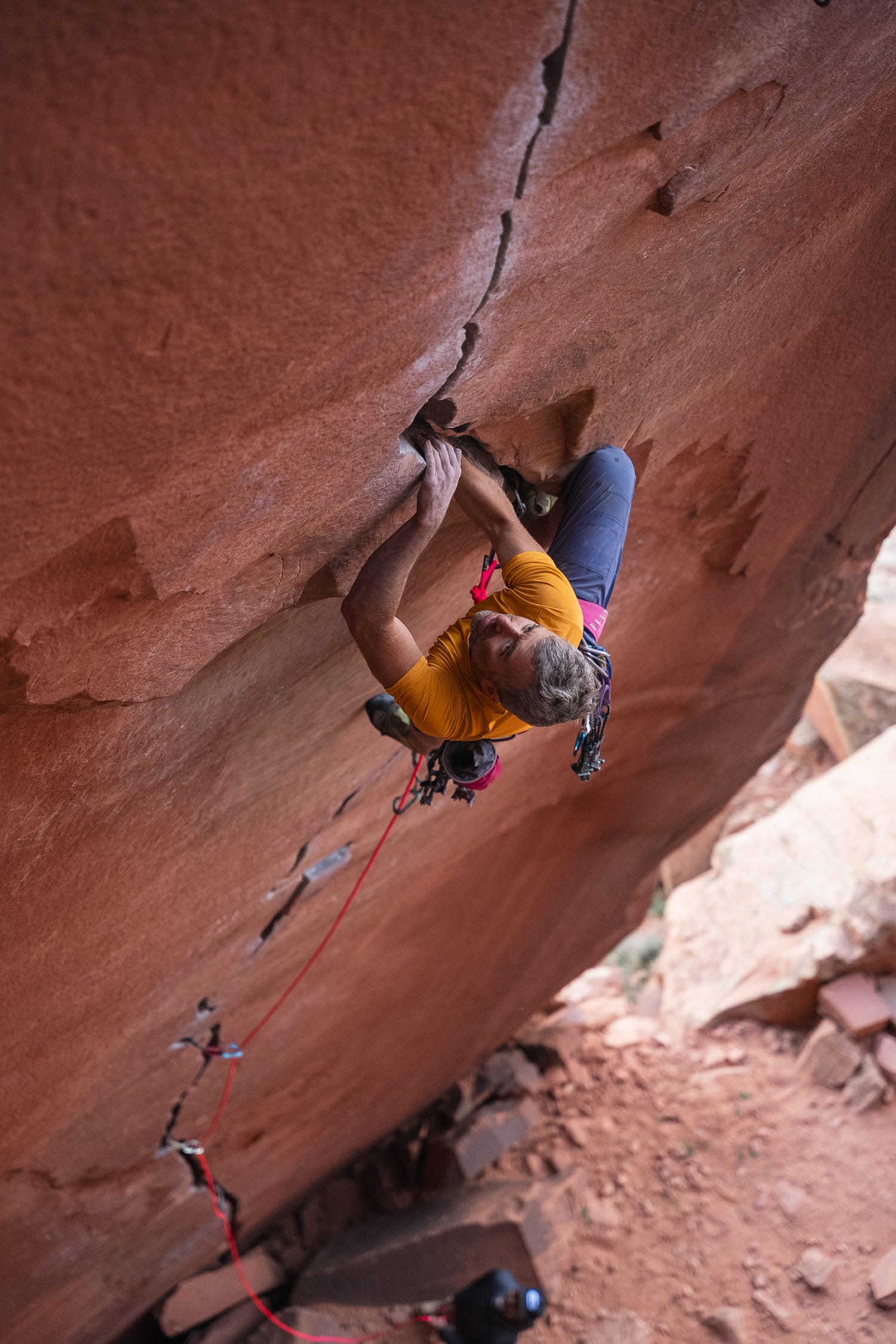
With climbing it’s harder. For some people, when they have to think—especially when they have to try and empathize and put themselves in another person’s life or shoes—it’s too much work. So they can be dismissive. But for me, there’s no choice. I’ll climb forever because it fills me with such joy and meaning. I feel such great presence and purpose. And my god, is it ever beautiful and fun and wild and unknown. It’s the basis of great art.
I wrote an article a few years back for a generalist audience with an aim of illustrating that climbing a big wall is not risky, willy-nilly walking up to it and going for it—that it’s the result of as many hours as mastery takes. For you, how has the rock been a teacher?
Whether it’s going bouldering or climbing something as big as El Cap, both bring you the same mindset: doing hard things and electively challenging yourself prepares you for when it’s involuntary. Opting in for discomfort, and dis-ease, and the unknown. Those options, if you exercise them, give you a fluency when you’re not opting in and it’s coming anyway. And that is great preparation for life.
It reminds me of a word Rhiannon used when I interviewed her. She said for her it’s all about “questing into the unknown.” I love the word “questing.”
Yes. And even if you’ve been there, it’s still a new you and a new day. I’m a repeater. I do the same climbs, same places. It’s like visiting a friend. I travel around the world and check out different places I haven’t been as well, but I love climbing right where I live, being right where I am, and coming home and seeing my family after a visit with some of the most meaningful and quintessential data points that helped me define my life.
In terms of repeats, I associate you with loving Royal Arches [a classic Yosemite climb]. When I did that climb, I believe my friend even referenced you calling it the best vertical hike in the park.
It’s interesting you mention Royal Arches as I was just thinking about this. I had my first kid, and then I had my second. They say the first kid changes your life and the second kid destroys it. So it had been a while since I climbed, and I went to this place called Sugarloaf close to where I live. I call it a Yosemite sampler—it has really fine-grained granite that is so delightful to climb, impeccable cracks and faces. It made me feel so good, and I realized, ‘Oh. I went and practiced my faith. I went and remembered this belief system.’ I felt whole again. Some people go to church; I go to Sugarloaf.
Do you have a definition of “home”?
I have a house where I live, and my wife and two children live here with me, and it’s absolutely a place I love and look forward to being at. But I feel very comfortable everywhere all the time, no matter what. At 19, I found that I was a member of this climbing community that was global—that hit me in Joshua Tree. I looked around and thought, ‘My god, look at all these people. They’re from all over the world, and they’re unlike anyone I’ve ever met before, but they’re just like me.’ I found my tribe. We have a common language—the appreciation of climbing, the application of climbing. And it takes us everywhere.
I can relate to that. When I’m climbing on Kalymnos, you have people from all over the world all together at the crag.
I also have many favorite words, one being “hearth.” It’s a fireplace and a metaphor for home. But in that word is also the word “heart,” is the word “art,” is the word “earth,” is the word “hear,” is the word “ear.” My version of home is my mind and heart, absolutely.
What questions are you asking yourself right now?
Why is there something instead of nothing? What is the point of existence? And then I ask myself things like, Why am I angry right now? Why am I frustrated right now? Why am I impatient right now? And those are really important questions. For me, there are the big, hairy, audacious questions about existence, and then there are the tedious, banal, everyday ones. But those small questions are way more important than the big, unanswerable ones, because the small questions bring the answers that we need to get through each day.
Do you think in terms of goals?
My biggest goal is equanimity. Homeostasis. To be at ease. I don’t have to feel great, but to feel good, to be good. And I can create that point of view, and I can be assessing those data points, and I can be determining how I’m doing. So practicing self-advocacy is huge for me.
I’ve noticed you’re a voracious reader—you’ve posted what you’re reading from any given summit. What are you reading right now?
I carry books with me everywhere, all over the world, all the time. I’m reading a book that was recommended by a dear friend. It’s sort of a preapocalyptic book about the American West and water, called The Water Knife by Paolo Bacigalupi.
Another important book is called Bury My Heart at Wounded Knee by Dee Brown. It was written in 1970. He takes the Native American point of view of being extirpated and is able to put together this terrible history in a way that you can understand the magnitude of the injustice.
I just finished Kim Stanley Robinson’s The High Sierra. A Love Story. He’s a sci-fi writer, so this is his only nonfiction book because he spent a vast majority of his life hiking cross country, no trails, in the Sierra.
And then I also just finished this incredible book by Doris Kearns Goodwin: An Unfinished Love Story. It’s about her and her husband, Dick Goodwin, who was a speech writer for JFK and LBJ. It’s a stunning read of their experience living in the 1960s, and the way that you create your personal history.
Tell me more about how you share books with others.
I have this years’ long art project I call “PicPickPost.” I give about 100 books a year away. What I do is text a person’s phone asking them to choose nonfiction or fiction, and then I send a pic of four different book covers, books that are important to me. They pick one, and then I post it to them using media rate. [How have I never known about USPS “Media Mail”?] I think of it as an autonomous book club—I’m not necessarily that concerned about what you’re reading, but that you are reading.
You’re also a great writer. Do you write regularly?
I do this thing I call “Life Notes.” These are letters, and I send out hundreds of them a year. They’re really purposeful, and they’re about acknowledgement, about gratitude, about awareness. They’re about some of the things I’m considering in the moment, like being a father, aging, love. They’re sweet, poetic outreaches that ground me, and then attempt to ground the other, the receiver.
You survived a sudden stroke while in the mountains of Patagonia; and then you and your wife dealt with the unimaginable when your son was in an induced coma after sudden respiratory failure. The writer Suleika Jaouad, who lives with cancer, has said that the worst advice she was given was to “live every day like it’s your last”; she instead talks about living every day like it’s your first—with wonder and presence and such. I’m curious if this resonates with you, as I get the sense that this is very much evocative of your spirit.
Sure does. Having kids helps you live in wonder and awe, moment to moment, because that’s where they live. And especially when they’re new, it’s like watching this incredible blossom unfolding. My daughter is only seven months old so she’s still just coming online, starting to notice and really wanting to take note of what’s happening around her, craning her neck and turning around. It’s so beautiful to witness.
To enter and to exit life are two of the most startling events in one’s own life, and two of the most startling events to witness when others come in and go out. I’ve often felt that in between my birth and death I’ll endeavor to live forever, in this sort of infinite now and the infinite possible, with a deep presence and appreciation of the audacity of life. How can it even be? When you think on an astrophysics level, when you think of the stars and the universe and the Big Bang…it’s so fantastical and impossible.
Touching the fabric of that more closely than others must be shifting, for better or worse.
It’s available. It’s right there. It’s a very thin veil known as permanence and perfection. If you can have the courage to pull it back, it’s surprising what’s on the other side. It’s beautiful. It’s a glimpse of the sublime.
I am not a climber; did it once and learned it wasn’t for me. But the questions you posed and Timmy’s answers got to some universal themes, IMO. Thank you!